Sunday, June 22, 2008

Burton's Deco Elephants


Burton's Deco Elephant, Belfast


Before I travelled to Belfast to catch up with my parents who were on holiday there, I found this Belfast Art Deco website about a building in Ann St which had these amazing elephant decorations (above & left).
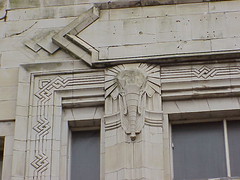
Burton's Deco Elephant, BelfastThe website said it was a mystery what the building was so I was thrilled when my Dad guided me to Ann St and on first sight of the building announced that it used to be Burton's the Tailors.

My Dad was born in Belfast and lived there for almost 30 years before we emigrated to Australia. You can't beat local knowledge.

The shop is quite small and bears two such stylised elephant heads as capitals to the columns dividing the windows on the building's facade. Other deco features can be see around the windows and on the cartouche at the top of the building which would have contained the Burton's name.

Belfast Art Deco website has since been updated and notes that the Ann St Burton's store was designed by a Burton's employee N Martin in 1932 while the elephants were designed by E A Moore.

The site also records that there are other Burton's stores in England also bearing elephants.

I discovered this for myself about a month after I returned to London where I was living at the time. I was driving around with a friend from Australia randomly spotting deco buildings when I saw the elephants again in Greenwich.
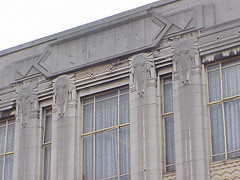
Burton's Deco Elephants, StreathamLater still, I saw them again in Streatham, South london (right & below). They were on a pub but there is no doubt the building is a former Burton's store.

It is bigger than the Belfast store and has four elephants but a lot of the other decoration is identical.

There is however one subtle difference. The elephant's tusks point outwards on the Belfast store and inwards on the Streatham store.
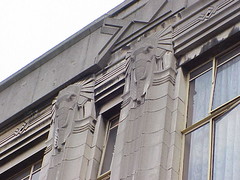
Burton's Deco Elephants, StreathamI am not a building expert but it looks to me that the Streatham elephants are cast in concrete where the Belfast ones are perhaps carved from stone. There is certainly more detail in the Belfast elephants and I suspect that those tusks would break off if they tried to produce them using a cast.

A search of flickr (see links below and please take the time to have a look at these great pictures) has revealed to me other locations in England where the Burton's elephants still gather including the Greenwich location where I had first seen them in England. All of the 'English' elephants have tusks that point inwards.

It seems these elephants continue to bring up questions.

Barking, uploaded by bowroaduk
Greenwich, uploaded by bowroaduk
Wolverhampton, uploaded by suselstahl
Oldham, uploaded by Stan.W
Weston-Super-Mare, uploaded by Fray Bentos
Halifax, uploaded by Martinish
Chatham, uploaded by BrianD36

Saturday, June 21, 2008

A Bar in Asmara


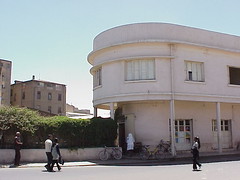
Bar, AsmaraThis is a great building. Virtually no decoration but a fantastic overall shape. The curved front could be the bow of a ship.

A thin eyebrow running aroun the whole building provides shade for the windows along the side but it is interesting to see a second eyebrow just above the two front windows.

Giuseppe Arata deigned the building in 1936 an it was built on the course of the Mai Bela River so the comparison with a ship is quite appropriate.

Today the ground floor is used as a bar with the area at the front providing a shaded seating area for customers to enjoy a cool beer.

Reference:
Asmara: Africa's Secret Modernist City~ Edward Denison, Guang Yu Ren & Naigzy Gebremedhim


Friday, June 20, 2008

Mosskito, Clifton Hill


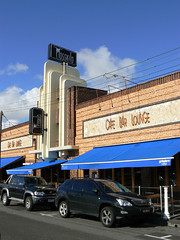
Mosskito, Clifton HillThis former garage in Clifton Hill, Melbourne provides the perfect landmark for the people at Mosskito to run their restaurant.

The horizontal facade features a mixture of brick styles to provide simple decoration and large rectangular rendered areas that are ideal for signage.

The most striking feature is the central column. Rendered cream against the dark of the bricks it provides a wonderful support for the retaurant name. Both vertically on the front of the building and also as a beacon on top of the column.

Another example of a how older buildings can be adapted and re-used to stunning effect.

Wednesday, June 18, 2008

Hoddle Bridge, Richmond


Hoddle Bridge

In 1837-38, surveyor, Robert Hoddle laid out a grid of streets for the new settlement of Melbourne then just a few years old.

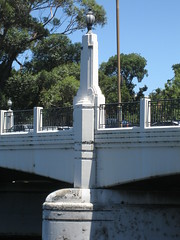
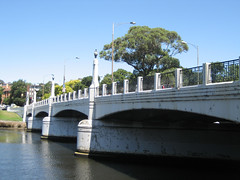
Pylon, Hoddle Bridge, RichmondA century later, Hoddle Bridge was completed at the bottom of Punt Road hill where in Hoddle's day, a punt would have been the only way to cross the Yarra River.

The bridge named in his honour, inscribed with the year 1938, bears many deco features.

The pylons cut through the water like ships bows. Each one supporting not only a span of the bridge but an ornate street light supported on an art deco column.

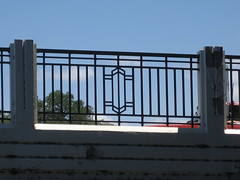
The metal railings, shown below, carry a simple geometric design.

Below the road level, the bridge looks a bit sad but the elegant lines shine through the flaking paint.

Railing, Hoddle Bridge, Richmond


Monday, June 16, 2008

former Shop, Port Melbourne


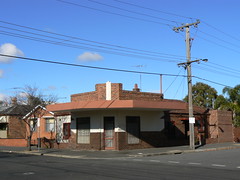
former Shop, Port MelbourneI don't know when this former shop in Port Melbourne was built but it was almost certainly while John Le Clercq ran his hairdressing business here.

It certainly is a modist building. The bottom half of the wall is constructed from a thinner style of brick when compared to the rest of the building. The top half of the wall is renedered but there are stepped decorations on the corners using the same bricks as the lower part of the wall.

Above the verandah, the parapet is made from standard bricks with a line of angled bricks adding subtle decoration just below the roofline. The central section consists of a simple stepped column, rendered to stand out from the red bricks.

John Le Clercq opened as a hairdresser here in 1932 and it is possible that the shop was built at that time, although there was a building on this corner before that. He worked here through WWII at least into the 1950s.

The Sands and McDougall directory of 1955 shows that it was still a hairdressers run by C Goldfarb. In 1965 C Fotter ran it and in 1973, D Nikolic.

In more recent times it has been converted into a residence, like so many corner shops, but we can still appreciate the its simple beauty.

Sunday, June 15, 2008

Police Booth, Asmara


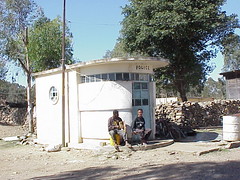
Police, AsmaraI love this little police booth on the outskirts of Asmara. It reminds me of a series of bus shelters in Brighton on the south coast of England.

It is small but it packs a punch. The flat roof, curved at the front and extending over the front wall to provide some relief from the African sun.

Even the wall are stepped inwards as they near the ground opposing the usual notion of the stepped skyscraper style.

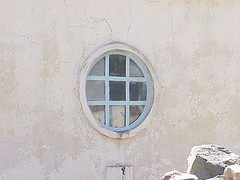
The windows are interesting. There is a band of square windows around the whole front of the booth just above the door and a segmented porthole window on each side.

Porthole Window, AsmaraThe booth seemed to be used as a checkpoint for traffic leaving Asmara on the way down from the plateau to Massawa on the Red Sea. An officer boarded the bus I was on but only checked the papers of a few people, all young men. There was no drama to the situation but it gave me time to take note of the booth and come back a couple of days later to take a few pictures.

Saturday, June 14, 2008

Cenotaph, Durban


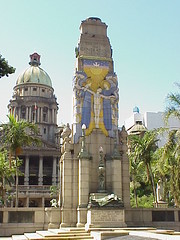
Cenotaph. DurbanThe War Memorial in Gardiner Street, Durban came about through an archtectural competition in 1921. The Cape Town firm of Eagle, Pilkington and McQueen won and the resulting structure was completed in 1926.

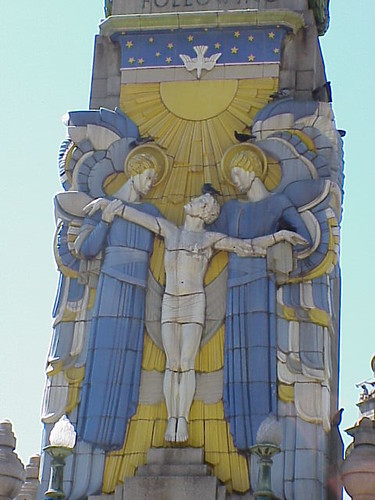
The most striking feature of the Cenotaph is the colourful sculpture of the fallen warrior being transported to heaven in the arms of two angels. Heaven in this case represented by an amazing yellow sunburst topped with a white dove and a starry sky.

The sculpture was completed by Harold and Phoebe Stabler of the Poole Pottery in England and shipped out to be assembled on-site.

It is a bit disconcerting to see such bright colours on a war memorial but the representations are so well done that respect is duely paid to the fallen regardless of the colours.

Cenotaph, Durban


Friday, June 13, 2008

Althea Court, Durban


Althea Court, Durban

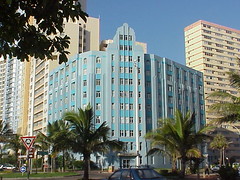
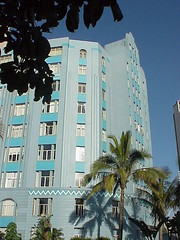
Althea Court, DurbanAlthea Court on the seafront in Durban has some nice decoration. It dates from around 1937.

The bottom two floors are divided from the rest of the building by a bold white zig-zag against the two-tone blue colour scheme.

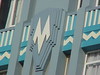
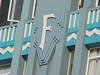
Higher up, deco shields hold the initials 'M' and 'F' with more zig-zag decoration. I wonder what or who they stand for?

Althea Court, DurbanAlthea Court, Durban

Thanks to Andrew Moore from the Deco Durban Directory for identifying this building for me.